

Introducing OvaCyte EQ Ano – Hit fastforward on monitoring equine tapeworm infection

Tapeworm infections occur in grazing horses worldwide, affecting horses of all ages and breeds. Among these, Anoplocephala perfoliata is recognised as the most prevalent and pathogenic species compared to two others of the same family, Anoplocephala magna and Paranoplocephala mamillana 3,5,12.
The prevalence of equine tapeworm throughout Europe varies depending on the method of testing used. A. perfoliata infection occurs worldwide, though reported prevalence varies widely — roughly 13–82% — depending on the country and the diagnostic method used.
Necropsy-based studies tend to report higher prevalence than other diagnostic approaches with figures ranging from 21% in the Netherlands, 24% in central Spain, 28.5% in Germany, 51% in Ireland, 64.4% in Iceland, and 65% in Sweden. The consensus is that equine tapeworm infection is common but often underestimated.
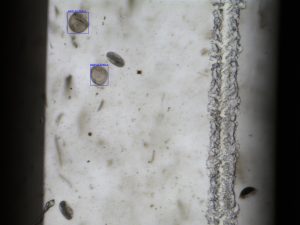 Equine tapeworm infection is primarily a pasture-associated infection acquired by ingesting infected oribatid mites, and pasture access is one of the most consistent risk factors across studies for infection 7,19
Horses infected with A. perfoliata can develop colic symptoms, as the parasites cause pathological changes at their site of attachment in the gut 8 . These changes can lead to serious complications, including intestinal obstruction, ileo-caecal or caeco-caecal intussusception, caecal perforation, and peritonitis — any of which can be fatal 7 . Others can present with non-specific signs including ill-thrift and weight loss 7.
This is not an absolute, however, and some horses with heavy burdens and significant pathological changes can remain clinically normal 14 . However, these horses still contribute to pasture contamination, making the identification of this cohort vital to an effective parasite control programme.
Many published studies support the fact that an increasing number of tapeworms present in the gastrointestinal tract increases the severity of the lesions seen 4, 8, 14. A burden of ≥20 adult A. perfoliata worms is the most commonly supported threshold likely to cause clinical disease, especially ileocaecal lesions and certain colic syndromes 4,7,9,11,15,17,20 .
Therefore, a faecal egg test capable of reliably detecting horses with a burden of 20 or more adult tapeworms would play a valuable role in both individual and herd-level parasite control programmes.
Faecal egg counts and equine tapeworm:
Faecal egg counts performed by the standard McMaster technique or comparable methods are recognised as having low sensitivity but high specificity for equine tapeworm infection 1,2,9,10,12,13 .
The detection of tapeworm eggs in faeces of an infected horse is limited by factors associated with the biology of tapeworm. The adult equine tapeworm intermittently releases gravid segments filled with eggs into the lumen of the intestine 2,13. These gravid segments then rupture, releasing eggs that are expelled in the faeces. The nature of this intermittent shedding means eggs are not always present in the faeces passed by an infected animal.
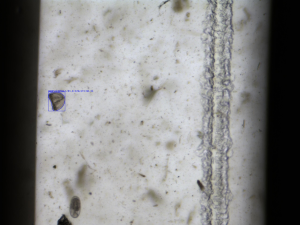 Furthermore, the eggs can be concentrated in one area and lead to uneven distribution of eggs across the entire dung pile 2. Therefore, it is extremely important to collect at least three samples from different faecal balls and mix the composite sample well before analysis 2. Finally, some horses have high proportions of immature and sterile adult worms that do not contribute to faecal egg production 10 .
Modified faecal egg counting techniques:
Modified faecal egg counting methods (involving larger faecal quantities and centrifugation steps) have been shown to increase the diagnostic performance of equine tapeworm faecal egg testing. A technique known as the Proudman-Edwards technique was first described in 1992. In the original study, the test correctly identified 61% of horses that had tapeworms and correctly ruled out 98% of horses that didn’t. When horses with fewer than 20 tapeworms were left out of the analysis, the test correctly identified 92% of infected horses 16 .
In a more recent Danish study, 84 horses at an abattoir were examined at postmortem and a semi-quantitative centrifugation/floatation faecal egg count method was assessed for reflection of actual Anoplocephala perfoliata burden. The study showed that faecal egg counts, when using an intensive 30 g centrifugation/flotation method, correlate closely with worm burden and are sensitive for clinically important infections (>20 worms), making them useful at the individual horse level 6 . A recent head-to-head comparison also found the Proudman-Edwards technique outperformed other recognised techniques for naturally infected horses 1.
However, all of these traditional modified techniques require multiple steps, specialist laboratory equipment, prolonged preparation time, and a level of parasitology training and microscopy expertise to accurately read and interpret slides.
Introducing OvaCyte EQ Ano:

OvaCyte EQ Ano has launched as part of the OvaCyte testing portfolio. Based on a proprietary modification of the Proudman-Edwards technique, OvaCyte EQ Ano combines advanced AI-powered imaging with a unique filtration step — and in direct comparison, outperformed the currently recommended centrifugation/flotation method for equine tapeworm egg detection.
In validation testing against the recommended testing protocol, OvaCyte Eq Ano demonstrated 96.4% sensitivity across mixed populations of horses tested, a marked improvement in diagnostic reliability. In low-burden challenge samples, OvaCyte Eq Ano identified 7 additional positives that would otherwise have gone undetected. This translates to superior performance in low-concentration samples and enhanced detection of low-burden Anoplocephala spp. infections.
With significantly less time and effort required to perform the test, OvaCyte Eq Ano makes reliable tapeworm detection more accessible than ever.
OvaCyte EQ Ano is designed to complement the OvaCyte EQ&LA Plus Equine FEC test.
OvaCyte EQ&LA Plus offers excellent performance for detecting the main parasite species in horses, including tapeworm.
 However, OvaCyte EQ Ano is built on a specifically designed preparation method with a superior detection limit compared to both McMaster and OvaCyte EQ&LA Plus. Where equine tapeworm is a specific concern, or where tapeworm monitoring is one cornerstone of a parasite control programme, OvaCyte EQ Ano should be conducted alongside OvaCyte EQ&LA Plus.
OvaCyte EQ Ano clinical interpretation:
OvaCyte EQ Ano is intended as an individual horse screening test. A result of 0 eggs detected indicates that no tapeworm eggs were detected in the sample analysed. This is consistent with the absence of a clinically significant adult tapeworm burden (>20 worms), although low/immature worm burdens or intermittent egg shedding cannot be completely excluded. Burdens below this level are generally considered to have limited clinical significance.
References
- Anderson, H., Warner, S., Ripley, N., & Nielsen, M., 2024. Performance of three techniques for diagnosing equine tapeworm infection. Veterinary Parasitology, 327, pp. 110152 . https://doi.org/10.1016/j.vetpar.2024.110152
- Buono, F., Castaldo, E., Veneziano, V., Veronesi, F., Roncoroni, C., Scarcelli, S., Sgroi, G., Matthews, J., & Piantedosi, D., 2025. Equine tapeworm infections in Italy: A nationwide coprological survey. Research in Veterinary Science, 188, pp. 105616 . https://doi.org/10.1016/j.rvsc.2025.105616
- Burcáková, Ľ., Königová, A., Kuzmina, T., Austin, C., Matthews, J., Lightbody, K. L., Peczak, N., Syrota, Y. and Várady, M. (2023). Equine tapeworm (Anoplocephala) infection: evaluation of saliva- and serum-based antibody detection methods and risk factor analysis in Slovak horse populations. Parasitology Research, 122, pp. 3037 – 3052. https://doi.org/10.1007/s00436-023-07994-1
- Fogarty, U., del Piero, F., Purnell, R.E.& Mosurski, K.R. (1994) Incidence of Anoplocephala perfoliata in horses examined at an Irish abattoir. Veterinary Record, 134(20), 515–518.
- Jürgenschellert, L., Krücken, J., Austin, C., Lightbody, K. L., Bousquet, E. and Von Samson-Himmelstjerna, G. (2020). Investigations on the occurrence of tapeworm infections in German horse populations with comparison of different antibody detection methods based on saliva and serum samples. Parasites & Vectors, http://doi.org/13. 10.1186/s13071-020-04318-5
- Kjær, L. N., Lungholt, M. M., Nielsen, M. K., Olsen, S. N., & Maddox-Hyttel, C. (2007). Interpretation of serum antibody response to Anoplocephala perfoliata in relation to parasite burden and faecal egg count. Equine Veterinary Journal. https://doi.org/10.2746/042516407X217876529
- Kukurić, T., Erdeljan, M., Matthews, J., Lightbody, K. L., Austin, C., Peczak, N., Uzelac, A., Klun, I. and Simin, S. (2025). A Prevalence Study on Anoplocephala in Serbian Horses: Navigating Diagnostic Challenges and Understanding Infection Risks. Animals : an Open Access Journal from MDPI, 15. http://doi.org/0.3390/ani15142094
- Lawson, A., Pittaway, C. E., Sparrow, R., Balkwill, E. C., Coles, G., Tilley, A. and Wilson, A. (2019). Analysis of caecal mucosal inflammation and immune modulation during Anoplocephala perfoliata infection of horses. Parasite Immunology, 41. http://doi.org/10.1111/pim.126
- Lightbody, K. L., Davis, P. and Austin, C. (2016). Validation of a novel saliva-based ELISA test for diagnosing tapeworm burden in horses.. Veterinary clinical pathology, 45 2, pp. 335-46 . http://doi.org/10.1111/vcp.12364
- Matthews, J., Peczak, N., & Engeham, S. (2024). Latest developments in testing for equine helminths. In Practice. https://doi.org/10.1002/inpr.391.
- Matthews, J. and Peachey, L. (2026). An update on equine tapeworm control in light of reports of anthelmintic resistance. Equine Veterinary Education. http://doi.org/10.1111/eve.70079
- Meana, A., Luzon, M., Corchero, J., & Gómez-Bautista, M., 1998. Reliability of coprological diagnosis of Anoplocephala perfoliata. Veterinary Parasitology, 74 1, pp. 79-83 . https://doi.org/10.1016/s0304-4017(97)00145-3
- Nielsen, M., 2016. Equine tapeworm infections: Disease, diagnosis and control. Equine Veterinary Education, 28, pp. 388-395. https://doi.org/10.1111/eve.12394
- Nilsson, O., Ljungström, B., Höglund, J., Lundquist, H. and Uggla, A. (1995). Anoplocephala perfoliata in Horses in Sweden: Prevalence, Infection Levels and Intestinal Lesions. Acta Veterinaria Scandinavica, 36, pp. 319 – 328. http://doi.org/10.1186/bf03547677
- Pavone, S., Veronesi, F., Genchi, C., Fioretti, D., Brianti, E. and Mandara, M. (2011). Pathological changes caused by Anoplocephala perfoliata in the mucosa/submucosa and in the enteric nervous system of equine ileocecal junction.. Veterinary parasitology, 176 1, pp. 43-52 . http://doi.org/10.1016/j.vetpar.2010.10.041
- Proudman, C. and Edwards, G. (1992). Validation of a centrifugation/flotation technique for the diagnosis of equine cestodiasis. Veterinary Record, 131, pp. 71 – 72. http://doi.org/10.1136/vr.131.4.71
- Proudman, C., French, N. P. and Trees, A. (1998). Tapeworm infection is a significant risk factor for spasmodic colic and ileal impaction colic in the horse.. Equine veterinary journal, 30 3, pp. 194-9 . http://doi.org/10.1111/j.2042-3306.1998.tb04487.x.
- Tomczuk, K., Kostro, K., Grzybek, M., Szczepaniak, K., Studzińska, M., Demkowska-Kutrzepa, M. and RoczeńKarczmarz, M. (2014). Seasonal changes of diagnostic potential in the detection of Anoplocephala perfoliata equine infections in the climate of Central Europe. Parasitology Research, 114, pp. 767 – 772. http://doi.org/10.1007/s00436-014-4279