

In the next of our 6 part OvaCyte Blog Series, we delve deeper into our Speciation offering, focusing on Nematodirus Battus and how OvaCyte can support your parasite control programmes! The word Battus finds its origins from Libyan kings, Greek cattle thieves, and German gold. Which is appropriate given that Nematodirus battus eggs are king-sized compared to other strongyle eggs and give off a gold hue when observed under the microscope.
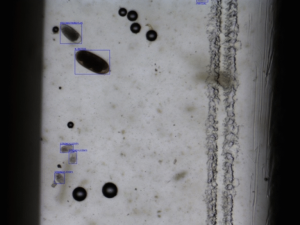
Image courtesy of Ovacyte™
Nematodirus battus is considered one of the most significant pathogens of sheep in Ireland and the UK. It typically affects young lambs between the ages of 6-12 week and can cause significant mortality in large outbreaks. Even on a milder scale it can impact production and affected lambs can have poorer growth rate and lower market value.
Nematodirosis, the name given to the disease in lambs caused by Nematodirus battus, follows ingestion of large numbers of larvae from the pasture. These ingested larvae cause severe disruption to the intestinal mucosa. Further development of the larvae into adults within the intestines cause further villous damage and mucosal erosion.
The clinical signs of diarrhoea, weight loss and anorexia result from the inability of the compromised intestine to regulate fluids and nutrient absorption. Affected lambs are weak and tend to congregate around water troughs. Mortality can reach up to 5% and surviving lambs may fail to thrive.
Farmers need to be aware that other parasites, such as coccidia, may be solely responsible for the diarrhoea seen in their young lambs or may be adding to the effects of the pre-existing Nematodirus infection. Therefore, all outbreaks of diarrhoea in lambs should be fully investigated so that suitable treatments and control measures can be advised.
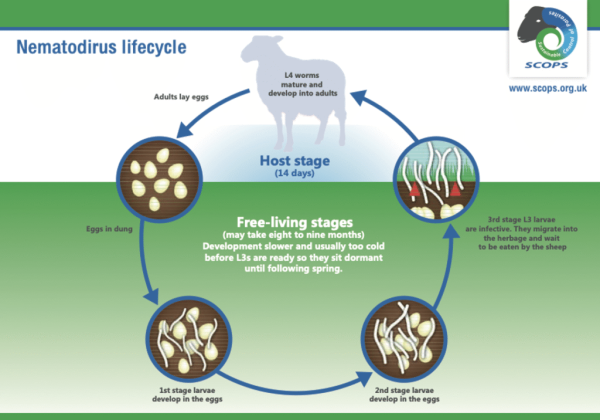
Nematodirus lifecycle
This disease previously was seen mostly in the spring. Before they can hatch, the eggs must undergo a period of cold weather followed by warmer temperatures of 10°C or more. If these conditions occur over a short period of time, triggering a mass hatch, and it coincides with the time when lambs are starting to take in significant amounts of grass (over about six weeks old), the result can be devastating.
However, Nematodirus battus can be considered a savvy bethedger as some eggs can develop without this prechill period. This allows it to secure hatching at other times of the year such as Autumn, thus ensuring yearly transmission of larvae even when conditions are not optimum. This means that disease can be seen later in the year than normally anticipated, when there may be susceptible parasite-naïve lambs grazing contaminated pastures.
Faecal egg counts (FECs) monitoring for Nematodirius battus:
To monitor FECs you need a reliable, repeatable, and rapid detection method to ensure precise, proper, and powerful results. Ovacyte is a point-of-care parasite egg recovery technology that allows inhouse faecal egg counts to be done with minimal user training.
Faecal sampling of lambs to diagnose nematodirosis may not have a positive result as the clinical signs are caused by the larvae. However, sampling of sufficient numbers of affected and normal lambs should reveal Nematodirius eggs in some animals. Low egg counts do not rule out infection as the females do not produce large amounts of eggs and FECs greater than 500EPG in association with history and clinical signs are considered diagnostic.
The role of routine FEC testing is paramount to an effective parasite control program. Using FECs gives valuable information on the contamination levels of Nematodirius battus going onto your pasture. Older sheep are considered to play a very minor role in the epidemiology of nematodirosis but positive FEC, even low, should be treated with caution given the large bulk of faeces excreted daily by larger animals. These animals will contribute to overall pasture load and can be a significant source of infection for next year’s lambs.
FECs can also be used to evaluate the effectiveness of a drug following administration by performing a faecal egg count reduction test (FECRT). With reports of recent emergence of benzimidazole resistance in UK Nematodirus battus populations strategic and effective dosing and pasture contamination level monitoring is now more important than ever.
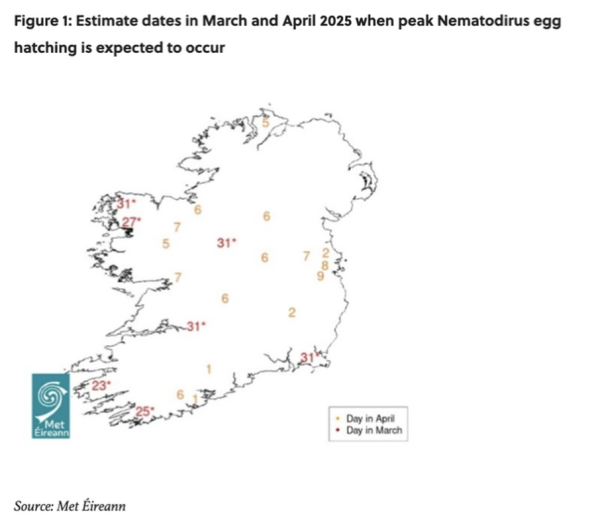
Met Éireann 2025 Nematodirus Forecast
Predicting Nematodirus battus hatching:
Forecasting tools based on environmental factors can help predict N battus hatch dates. However, these are based on classical Spring chilled hatching and may leave farmers exposed to unexpected disease at other times of the year. Detailed individual farm knowledge including FECs inform individual prediction models and management strategies for effective control measures.
OvaCyte Speciation, including testing for Nematodirus Battus, is now available in the UK on our EQ & LA Plus Cassettes, and will be available in Ireland in November 2025 on our EQ & LA Dual Cassettes. Contact us for more information.
References:
Abbott, K.A et al (2012) “Sustainable Worm Control Strategies For Sheep” 4th Edition.
Forbes, A (2021) ‘Parasitic gastritis in sheep: haemonchosis; and parasitic enteritis in lambs: nematodirosis’, in Forbes (ed.) Parasites of Cattle and Sheep: A Practical Guide to their Biology and Control’ CABI pp 64-87
Melville, L.A et al (2020) Variation in hatching responses of Nematodirus battus eggs to temperature experiences’ Parasites & Vectors, 13, pp 1-8
Melville, L.A et al (2024) ‘Refugia, climatic conditions and farm management factors as drivers of adaption in Nematodirus battus populations’ Veterinary Parasitology, 327
Van Dijk, J & Morgan, E (2008) “The influence of temperature on the development, hatching and survival of Nematodirus battus larvae’ Parasitology, 135, 269-282